 Cardiovascular Physiology Concepts, 3rd edition textbook, Published by Wolters Kluwer (2021)
 Normal and Abnormal Blood Pressure, published by Richard E. Klabunde (2013)
The Pharmacologic Treatment of Angina cont.
- Page 1: Causes of Angina
- THIS PAGE: Types of Angina
- Page 3: Antianginal Drugs
Types of Angina
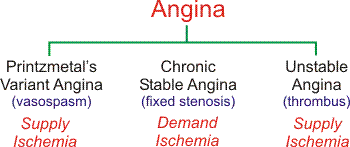 There are three types of angina: Printzmetal's variant angina, chronic stable angina, and unstable angina. All three forms are associated with a reduction in the oxygen supply/demand ratio.
Variant (Printzmetal's) Angina
Variant (Printzmetal's) angina results from coronary vasospasm, which temporarily reduces coronary blood flow (i.e., produces ischemia by reducing oxygen supply; "supply ischemia"), decreasing the oxygen supply/demand ratio. Enhanced sympathetic activity (e.g., during emotional stress), especially when coupled with a dysfunctional coronary vascular endothelium (i.e., reduced endothelial production of the vasodilators nitric oxide and prostacyclin) can precipitate vasospastic angina.
Chronic Stable Angina
Chronic Stable angina is caused by a chronic narrowing of coronary arteries because of atherosclerosis. When a coronary artery is narrowed beyond a critical value (critical stenosis), the myocardial tissue perfused by the artery will not receive adequate blood flow (i.e., the tissue becomes ischemic and hypoxic). This is of particular concern during times of increased oxygen demand (e.g., during physical exertion). Because the relative ischemia occurs when the oxygen demand increases, this is referred to as "demand ischemia." This will lead to anginal pain or chest discomfort during physical exertion. The pain is usually associated with a predictable threshold of physical activity. Other conditions that cause myocardial oxygen demand to increase, such as a large meal or emotional stress, can also precipitate pain.
Unstable Angina
Unstable angina is caused by transient formation and dissolution of a blood clot (thrombosis) within a coronary artery. The clots often form in response to plaque rupture in atherosclerotic coronary arteries; however, the clot may also form because diseased coronary artery endothelium produces less nitric oxide and prostacyclin that inhibit platelet aggregation and clot formation. When the clot forms, coronary flow is reduced, leading to a reduction in the oxygen supply/demand ratio ("supply ischemia"). If the clot completely occludes the coronary artery for a sufficient length of time, the myocardium supplied by the vessel may become infarcted (acute myocardial infarction) and become irreversibly damaged.
Go to Next Page
Antianginal Drugs
Revised 11/30/2023
 Twitter
 Telegram
 LinkedIn
 WhatsApp
 Facebook
 Reddit